Cars.Code.Cashflow in Munich: Data Driving the Next Phase of Mobility
- Capy B.

- Dec 8, 2025
- 2 min read
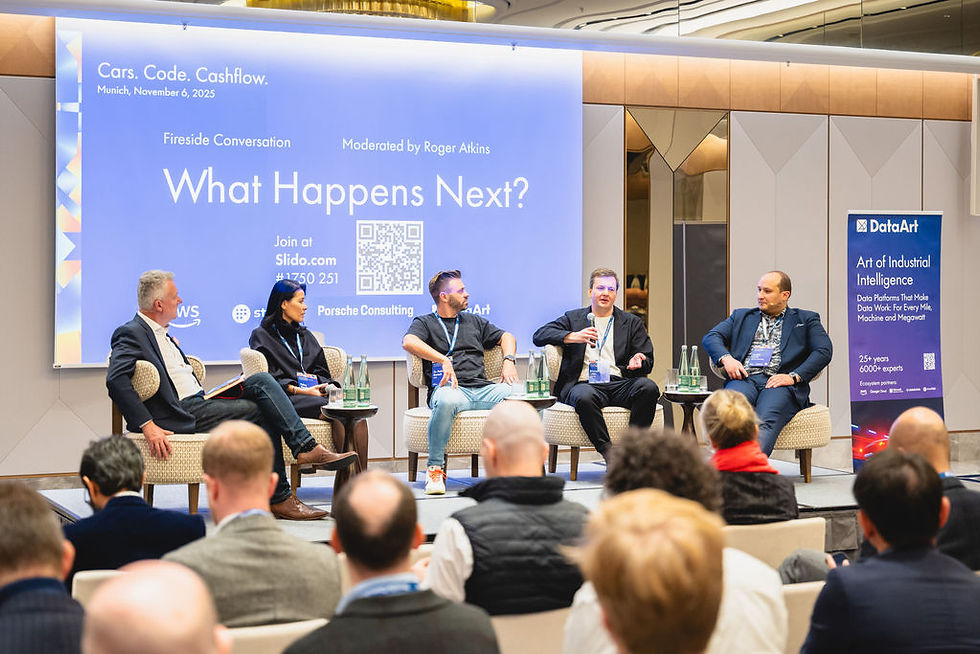
DataArt, AWS, and Porsche Consulting hosted Cars.Code.Cashflow at the Rosewood in Munich. An intimate but high-impact gathering where experts from mobility, energy, manufacturing, and logistics met to examine how data can generate tangible business outcomes. The limited size of the event created space for focused dialogue, insightful exchanges, and a clear look at the challenges and opportunities shaping the future of mobility.
Paksy Plackis-Cheng, Co-Founder and Chief Strategy Officer of Staex presented an actual case study sharing her views on how decentralized infrastructure supports the evolution toward Software-Defined Vehicles (SDVs) and why trusted data are becoming a foundational requirement. In the emerging machine economy, where devices increasingly communicate and operate autonomously, verifiable and tamper-proof data is no longer optional, but essential.
The Multi-Layered Complexity of Mobility Today
The mobility industry is navigating overlapping layers of complexity. Technical constraints, expanding security requirements, privacy obligations, regulatory frameworks, and shifting business models all demand coordinated responses. Organizations must process massive data volumes, manage network reliability, comply with regulations such as GDPR and UNECE standards, and at the same time explore viable paths to data monetization.
This complexity leads to a central question:
How do we ensure the data we rely on is trustworthy?
Staex’s Perspective: Trust Begins at the Machine

Staex approaches this challenge from the most fundamental level, the machine itself. Instead of trying to validate data only after it enters the system, Staex ensures that data is signed on the device, complete with time stamp and location information. This provides:
verifiable data provenance,
authenticity tied to a specific device,
protection against manipulation during transmission,
and a reliable foundation for AI-driven decision-making.
In an era where inaccurate or corrupted data can mislead models and distort outcomes, establishing trust at the point of creation is a critical structural requirement.
Key Themes Discussed at the Event

Cars.Code.Cashflow brought together diverse viewpoints from across the mobility ecosystem, prompting practical discussions on what it takes to create value from data today.
Core discussion points included:
data architectures suitable for SDV platforms,
realistic pathways to data monetization,
the influence of regulatory frameworks on technology choices,
the need for stronger cross-industry collaboration,
and the role of German engineering and infrastructure technologies in enabling these changes.
Experts from leading organizations: AWS, Porsche Consulting, Mobility Data Space, DataArt highlighted the structural obstacles facing the industry but also the opportunities.
Beyond Technology: Evolving How We Work Together
A recurring theme throughout the event was that technology alone will not solve mobility’s challenges. Progress depends on organizations and individuals adopting new ways of collaborating, integrating technologies, and moving beyond long-standing but outdated approaches. Several participants shared how many recent achievements in the ecosystem were made possible simply because a few teams chose to experiment, cooperate, and challenge the status quo.
Moving Forward
Cars.Code.Cashflow was not just another event, it marked the beginning of deeper industry dialogue around trustworthy data, decentralized infrastructure, and the machine economy. The discussions in Munich will continue to evolve into new collaborations, projects, and frameworks as more organizations look to build mobility systems that are reliable, compliant, and ready for the next technological era.
The momentum is just starting, and the path ahead will be shaped by those willing to rethink how the mobility ecosystem works—together.
All photos: © Seemann Media


Comments